Thursday, October 22, 2015

Wlil we ever learn?


The more I study scripture, the more I realize how we humans seem to repeat the same patterns over and over.  The Israelites of the old testament consistently came back to God.. but then as soon as they got comfortable... fell off again to do other things. An endless cycle of falling away, hearing God's call, coming back.. then falling away again.

It's easy to judge them harshly isn't it?  Looking back we see how stupid it is to do that.. but then when we look at our own lives, we find that same pattern.  After a disaster like 911, the pews are full.   People come looking for answers.  Looking for comfort.  Looking for hope.   They stay for a while, but eventually it begins to dwindle again.  They go back to their lives, their comforts, their 'joys.'   The same with all of us really.   Even those of us who continue go to church find ourselves in ruts.  We find ourselves in the pew becoming mechanical for a while.   Then we go on a retreat weekend, have some of those nice mountain top experiences, and then we are charged for a while.  Then that 'buzz' begins to fade and we go back to our old ways.

Saint Paul in the first reading for tomorrow talks about this.  He talks about how hard it is to not sin.  That though our will is so very ready to do the right thing, we find ourselves falling away to do the other.   How that our mind and desires are at war with each other.   We know the right thing to do, but our flesh wants us to do the thing that feels good.  We want to listen to those things that entice our ears, eat those things that entice our pallets, touch those things that tickle our senses.   Then we fight with that desire trying to do the 'good' thing, and avoid the bad.  Then he cries out at the end of this dissertation "Who will deliver me from this mortal body?" Thanks be the God through Jesus Christ our Lord.

That's really where I find myself having the most trouble.  It's not that I don't know the right thing to do, my conscience is well informed.   It's not even that I am not making a commitment to do the right thing either.   I do truly and firmly mean it when I say in confession that I intend to change.  The real problem is when my ego gets in the way.   When I say "You know, I think I've finally beat this habit."  When I start feeling like my own personal discipline and effort has somehow made me a better person.  Rather, I agree with Saint Paul the Apostle, when he says: "I know that good does not dwell in me, that is, in my flesh."

What I suggest though is a different way to overcome those sins.  (We all have them btw, that personal sin that we just can't seem to shake.  That thorn in our flesh that God does not take away.)  That sin that we constantly need to confess and repent of, and we keep trying to do better but failing... How do we overcome it?  We do resist it.  We do try to mentally and physically prepare ourselves to avoid it.  We avoid whatever occasion of sin that draws us to temptation.  Then we give it over to God, and ask him instead to 'get this.'   It's no longer me saying "I got this,"  but rather me saying "you got this." It's when I allow God's grace to flow through me via the sacraments, when I prayerfully look to God to cleanse me of my sin, and then work with him, not on my own.. but aligning my free will with His will that things begin to change. 

That to me is the meaning of Holiness.   To align our will with God.  To conform ourselves to Christ.  As the Psalm declares:

R. (68b) Lord, teach me your statutes.
Teach me wisdom and knowledge,
for in your commands I trust.
R. Lord, teach me your statutes.
You are good and bountiful;
teach me your statutes.
R. Lord, teach me your statutes.
Let your kindness comfort me
according to your promise to your servants.
R. Lord, teach me your statutes.
Let your compassion come to me that I may live,
for your law is my delight.
R. Lord, teach me your statutes.
Never will I forget your precepts,
for through them you give me life.
R. Lord, teach me your statutes.
I am yours; save me,
for I have sought your precepts.
R. Lord, teach me your statutes.

Jesus reminds us in the Gospel that we have been given reason, logic, and the faculties to understand and make use of both.  He reminds us that we know what is right, why do we keep doing wrong and having to go the magistrates to solve our issues?  Rather shouldn't we just give it over to God and lower our ego, settle our petty differences and avoid any sort of prison?  What does this mean spiritually?  Are you looking for the signs?  Do you look to see if you are ready?  Do you examine your conscience daily?  And when you find that you've done something wrong?  Instead of waiting for the day of Judgement do you throw yourself at the feet of God, asking for his mercy now while on the journey, before you get to the 'court'?   Do you receive the sacraments regularly?  Confession?  These are our ways of settling now, by casting our sins down at the foot of the cross and allowing God to forgive our debt now.. because if we wait till the last day... well, it'll be too late to settle.  Get ready, be ready, stay ready. 

In Christ, His servant, and yours;
Brian


Monday, October 19, 2015

Get ready? Be ready? Stay Ready?


Tomorrow's first reading is one of the more beautiful expressions of how important it is to realize who Christ was to the Jewish faith, the second Adam.  That's a powerful typology that we must not miss when exploring what it means to us as Children of the most high God.  To really understand this verse, we have to look at what happened in the Garden of Eden. 

If we look at Genesis starting with Chapter 2, we see that Adam was created to work and till the land.  Many scholars indicate that the wording used place Adam as it's guardian, it's protector.  He was supposed to keep bad things from happening, and to make sure good reigned supreme. Then comes the scene all of us are so familiar with.  The serpent appears. He tempts Eve.  Where was Adam during all this?  Right there by her side. He didn't stop her.  He didn't protect her.  He simply stood silently while mankind fell from the grace he had already experienced.

Think about the story here.  God was right there with him.  When the wind would blow He walked with Adam, face to face.  Adam had everything he needed.  He had all these beautiful animals, plenty of plants and seeds for food, this luscious garden filled with beautiful sights, and this gorgeous woman who he lived with and was supposed to protect.   All God asked was that they follow a simple rule.  Adam failed as the protector.  He didn't step up and say, wait.. God doesn't want that.. Eve don't listen to the serpent.  No, he simply watched her do it.. then partook of the forbidden fruit himself... then turned around and blamed God for the whole mess.  "It was the woman YOU gave me."

For just as through the disobedience of one man
the many were made sinners,
so, through the obedience of the one
the many will be made righteous.

You see, Adam's greatest sin, mankinds greatest sin, was really disobedience.  Jesus came into this world to restore us, through obedience.  Through that obedience we receive the righteousness we don't deserve.   That sets the stage for this interesting gospel:

Jesus said to his disciples:
“Gird your loins and light your lamps
and be like servants who await their master’s return from a wedding,
ready to open immediately when he comes and knocks.
Blessed are those servants
whom the master finds vigilant on his arrival.
Amen, I say to you, he will gird himself,
have them recline at table, and proceed to wait on them.
And should he come in the second or third watch
and find them prepared in this way,
blessed are those servants.”

What does Jesus mean?  For me he is talking about obedience.  He is talking about stewardship.  He is talking about living our lives in a way that says we believe what we profess to believe.  Stewardship is not just about tithing or giving a donation in the basket.  It's about every aspect of your life.  What you eat.  What you drink.  What you wear.   Where you go.  What you watch.  What you say.   In every action, we should show through what we do what we believe.  If we believe that this world belongs to God.. our actions should show that.   Do we?   Would all of us be environmentalists if we did?   Would we leave the lights on at night if we truly believed it all belonged to God?  Would we buy food based on taste alone? Or on both taste and sustainability?   Would we take our kids to see a movie that doesn't help them spiritually just because everyone else had seen it? 

What about you?  Are you prepared for him at any moment? Too many are out there looking for signs in the heavens, trying to predict the day he comes back... they want us to believe in a rapture that we need to be watching for.  They live in a panic, watching the news for this or that, stocking up to provide for those days they'll have to hide from governments etc... all of this belies what we should believe.  Rather we should get ready.  That is try to live a holy life, with frequent reception of the sacraments.  We should be ready.  Study to show ourselves approved.  Pray constantly, without ceasing.   Again, frequent reception of the sacraments!  Stay ready.  When we fall, and we will.. all of us fail at some point or another.. when we fail, we go back to Christ and start over.. we go to confession... did I mention frequent reception of the Sacraments? 

Just remember, not a single sparrow falls from the sky without God being aware of it... and you.. you are worth more than many sparrows.. you are worth dying for.  You are worth God coming down every single day to allow you to place him in your hands, receive him in your body, and be transformed through the Sacraments into the people he created us to be.   We have our chance to stand up to that tricky snake in the garden and say "hey back away from my spouse... I am a child of God and we won't let you trick us!"  Are you ready?

Get ready.  Be ready.  Stay ready.

In Christ, His servant, and yours,
Brian

Sunday, October 18, 2015

Take Care


Such a simple line from tomorrow's gospel.  It really triggers some thoughts from the books I am reading, the scriptures I am studying, and even some of the discussions I've been a part of.  It's funny how the Holy Spirit works that way, eh?  "Take care and guard against all greed."   Jesus then goes on to talk about a man who doesn't have enough to store all that he has, so he makes grand plans to provide for himself so he can have a long and happy life.  Yet, that very night he is doomed to die.  Then who will have all the stuff he has stored up?  To who will that belong?

I think this is truly a call to stewardship.  I have been studying that a lot the past few years, and more especially for an upcoming class in Aspirancy formation.  What is Stewardship indeed?  Many think of it as tithing, as giving a part of your money.  Or just giving some of your time.  Those are involved in it, sure.  Stewardship is so much more.  Stewardship is giving of self.   It is giving everything you have, everything you are, everything you are to become... giving all of that to God for his Kingdom, and to your neighbor as you would yourself.

That's a tall order isn't it?  Pouring yourself out like a libation?  Giving of yourself so much that it hurts?  Blood sweat and tears!  Are we ready to do that?  Wow, how hard it is sometimes just to give up a few minutes of our time in prayer.   We sometimes get grumpy or angry when our kids want this or that, or our spouse demands this time or that time, when we had plans to do our own thing.  In the long run, God calls us like this man in the Parable.  He says, you fool... tomorrow you could be called away.. what is most important?  God.  Family. Friends.   You see, I don't think the rich man in the parable had a problem because he was rich.  I think his problem became that he wanted more, and more.   Instead of giving away all this excess, instead of sharing it with his neighbors and friends... he wanted to build even bigger barns and storage bins.  Not so he'd have more to give away.. but so that he could party and relax. 

We are called to emulate our Lord Jesus Christ.  As the first reading says, Jesus was handed over for our transgressions, and raised for our justification. In what ways can we do this in our daily life? Hand ourselves over for others?  Becoming stewards.  Not just of our talents.   Not just of our monetary treasures.   Stewards of our entire lives... time, friendships, creation, economic, political, every sphere that we are involved in should be for God.   Every action, every thing we put in our bodies, every thing we say, every purchase, every television show, every song, every breath, every thought and dream... should be for God's glory.. and for the benefit of mankind.   That is, we should be bringing God's kingdom here and now.   That is what being a Steward is.  Knowing that God has given you everything you have, even the very life coursing through your body.  Our response?   Giving it back to him.. in every way possible.

In Christ, His servant and yours,

Brian

Saturday, October 17, 2015

Misericordia

Tonight I attended a Spanish Mass at our Parish.  Both to work on my Spanish listening skills and to
attempt to build some friendships and familiarity with a part of the Parish that I often do not get to see.  I have several friends who come to daily Mass or who are involved in other ministries whose native tongue is Spanish and it was good to see them and spend time with them in worship.  I did feel a little out of place though.

Why?  Probably ego?  Pride? Unfamiliarity?   It was good for me though, that is for sure.  I kept hearing this one word though, one I recognized from my studies and from preparing before hand.  "Misericordia."  Mercy.  Kindness.  I heard it in the antiphon of the Psalm.  I heard it in the singing.  I heard it in the readings.  I heard it Father Dorado's homily. (Most of which I was lost in, but I did understand parts of it!)

At the end a friend of mine, Ignatio, grabbed my hand and welcomed me.  Made sure to encourage me and talked about his experience of going to daily Mass in English.  He talked about how he at first did not understand much, but now after a few years, really has begun to understand it well enough to feel comfortable.  Here was a man willing to put his ego to the side.  A man willing to go where he was uncomfortable, where he didn't know many, but persisted through those feelings in order to learn enough of a language to help those of us who did not know his own to be able to experience one another in the body of Christ.

There are those out there who will tell you, "You are not an American if you don't speak English."  "I refuse to learn another language!"  "Why the hell should I have to press 1 to get English? This is America!"  To that I say rubbish.  Today's gospel calls out to us to put ourselves to the side and to instead humble ourselves to be servants.  Servants don't make those they are serving learn their language, rather they humble themselves and put forth the effort to learn the language themselves. "You know that those who are recognized as rulers over the Gentiles lord it over them, and their great ones make their authority over them felt.  But it shall not be so among you. Rather, whoever wishes to be great among you will be your servant; whoever wishes to be first among you will be the slave of all." 

Think about this for just a moment.  The God of the universe is so far beyond us that it would be like comparing a human to a worm.  This God of ours humbled himself so much that he condescended into one of us, becoming one of us in every way, except sin.  He learnt our language.   He took on our ways.  He didn't expect us to suddenly learn to speak God's tongue.  How much more so should we be willing to approach our brothers as if they were Christ himself?  Learning a language is the least we can do.   Learning who they are, where they are from, their name;  those are other steps we should take.  Their customs, their cultures, their families.  They are part of us.  We are one body.  There aren't 500,000 bodies of Christ.. only one. 

So go out into the world.  Serve your brothers and sisters.  Learn to speak to them.  More importantly learn to listen and understand them.  Try to learn their names.  Their families.  Their interests.   Let them know how important they are to you.  How much you love them.   Don't expect anything in return.  Just offer yourself for them, as Christ offered himself to us.  Then we can cry out together, with our brothers and sisters, in all tongues: "Lord, let your mercy be on us, as we place our trust in you."

In Christ,
His servant and yours,
Brian


Wednesday, October 14, 2015

Killing The Prophet

In Tomorrow's Gospel we see Jesus again speaking gloom and doom to the Pharisees and Scribes. It's easy for us today to look back and almost cheer him on, 'get those bad Pharisees!'  We like to have an enemy, a they, to place all the blame on.  We want to be on the side of good.  It's easier to feel like we are when we place all the blame on 'them.'  When we really examine what Jesus said though, it might make us squirm a little ourselves.

"Woe to you who build the memorials of the prophets whom your fathers killed. Consequently, you bear witness and give consent to the deeds of your ancestors"

Jesus reminded them by their very actions they supported the actions of their ancestors.  In building these tombs and monuments they are applauding the events that happened, as if they are proud of their ancestors for killing the prophets sent to them with God's word.  I'm not guilty of that, we say.  I never killed anyone and surely I've never applauded anyone for doing so? 

Yet, every time we are complacent in someone's sin.... every time we stand idly by not condemning bad actions or aiding in reformation of behavior... we have consented to their deeds.  When we buy that coffee from that organization we know does things we don't approve of, we have consented.   When we vote for that candidate that we know stands for something that is against our faith, we have consented.   When we stand in silent agreement, even nodding our hands, as someone gossips and tears down another individual... we have consented. 

How?  Jesus Christ died on the cross for our sins.   Every time we allow a sin to occur without speaking up, we have killed the prophet.  In a way we are worse than the Pharisees indeed.   They supported the actions of their fathers who killed the prophets before them, but we support the actions of those who are responsible for God himself having to go to the cross and die in our place... in fact, not only do we support those actions.. we often are the ones committing them.   "Woe to you who sin or stand silently while another sins, You have taken away the key of knowledge. You yourselves did not enter and you stopped those trying to enter."

Even more telling is the response of the Pharisees and Scribes, they began to interrogate him "for they were plotting to catch him at something he might say."    How many of us have at some point in our life tried to get around something God has told us?  "Ooh, I'm supposed to Fast on every Friday, but if I give up chocolate that's kind of fasting."   "Technically, even though Mass starts at 8, Communion doesn't occur till 8:30.. so I can eat at 7:30."  How often do we look for ways around doing what we should?  Plotting to get around what God said, or to twist it into something that is more convenient or easy for us. God forbid!

There is hope though!  A great light shining in the darkness!  "For there is no distinction; all have sinned and are deprived of the glory of God."   The first reading reminds us that Jesus, though we didn't deserve it, through God's grace and grace alone, provided a way through our human weakness, through His sacrifice on the cross.   To both Jew and Gentile, all of mankind, is the offer of salvation and freedom from sin.  Faith!  We must grow in this grace and learn to have faith in God.   That even when we fail, even when we sin, we must place that sin at the foot of the Cross, trusting in his forgiveness.   We go to the Church, we go to the Sacraments, we ask Jesus for his Grace and we know that it will come.    We ask him to come and change us, to help us grow and to do better next time. As the responsorial Psalm reminds us, "With the Lord there is mercy, and fullness of redemption." 

Tomorrow as we celebrate the Memorial of Teresa of Jesus, let us remember to increase our time with the Lord.  Let us reach out to have a mystical experience with him.  Let us find him in the stillness of our heart and the silence of prayerful contemplation.  Tomorrow, find a moment to invite God into your life and simply sit with him, singing in prayerful confidence:


Out of the depths I cry to you, O LORD;
LORD, hear my voice!
Let your ears be attentive
to my voice in supplication.
If you, O LORD, mark iniquities,
Lord, who can stand?
But with you is forgiveness,
that you may be revered.
I trust in the LORD;
my soul trusts in his word.
My soul waits for the LORD
more than sentinels wait for the dawn.


In Christ,
Brian


Tuesday, October 13, 2015

The Penitent Man Shall Pass

One of the most memorable scenes for me in the movie Indiana Jones The Last Crusade was the one where Indiana began to figure out the first trap.  The tension had built to a climax as his father lay dying on the ground from a gunshot wound, the Nazi antagonists were waiting in the wings to kill
him, several of the corpses of those who had attempted this quest laying on the ground around him.  As the air begins to swirl again, Indiana began to mutter to himself over and over, "The penitent man shall pass."  It was only when he realized that a penitent man was one who was on his knees before God, that he dropped into a humble position, quickly dodging the nearly invisible saw blade, performed a back flip, and then snagged the whole apparatus with a very conveniently placed rope. 

As I meditated upon the readings for tomorrow (Oct 14th, 2015), that word impenitent jumped out at me reminding me of this heroic scene.  In both the first reading and the gospel we see people being reminded of the need for not just justice, but also for mercy.   That the core of Jesus message is to bring about a metanoia experience in which the person turns from their former ways and experiences true conversion.   True conversion brings about not just a spiritual, internal change, but an outward change expressed in and through good works.

Then Jesus hears from another voice crying out, but Lord your word cuts me to the quick, surely you don't mean me as well?  To which Jesus quickly affirms "Woe also to you[..]! You impose on people burdens hard to carry, but you yourselves do not lift one finger to touch them."  Jesus makes sure to call out to all of those in his audience who aren't living an authentic life, one tempered in covenantal love.  He calls out to us to express our relationship with God in good works, in loving one another, in being merciful because we remember the mercy with which God has already showered each and everyone of us.

As I watch the news and read my different social media, I see so much going on in the world that shows not only a lack of justice but also a great lack of mercy.  We see refugees being expelled from their country, Christians being martyred and crucified, fleeing refugees being refused entry and even basic necessities out of the inconvenience that might cause any nation that chooses to accept them.  We see people proclaiming each and every immigrant to be a thug, a vandal, a radical adherent to a religion... guilty of some subterfuge or plotting to destroy the nation from within.

Maybe some of them are indeed that sort of person.  What though of the women?  The children?  The
young?  The widow and the orphan?  The broken and down trodden?  How do we justify the refusal to feed and clothe the least of these while also proclaiming to be Catholic? Then again do we have to look so far from home and into such an extreme to find the lack of justice?  What of the man on the corner who asks for money?  Have we not become so jaded that often we don't give him money, money that is only ours by the grace of God, because we fear what he might do with it?  Do we fret over the neighbor who parked his car in front of our drive? Or the team mate who did not pass the basketball but scored his own basket?  

There are too many missed opportunities out there to show God's mercy and justice to others.  We have a lot of work to do in this world.  We pray daily that His kingdom come and His will be done, but do we truly mean it?  After all, as Mother Teresa said, “At the end of life we will not be judged by how many diplomas we have received, how much money we have made, how many great things we have done.  We will be judged by "I was hungry, and you gave me something to eat, I was naked and you clothed me. I was homeless, and you took me in.”   I pray that we will open our hearts to God's mercy and justice, that we might hear "Well done my good and faithful servant," and not  “Woe to you! You are like unseen graves over which people unknowingly walk.”

In Christ,
Brian

Monday, October 12, 2015

The Heavens Proclaim the Glory of God

My wife and I have made it a habit lately to jog in the late evenings after all of our obligations and such begin to wind down.  Tonight as I meditate on the readings for tomorrow's Mass, it reminds me of the jog/walk we just completed.   I was in just too much pain to run tonight, so I ended up walking most of the time we were out there. It helped me though to think quite a bit about many of the things I've been mulling over, and more especially to spend some time just walking along talking to my sacramental partner.

Tomorrow's readings are some of my favorites in scripture.  As we walked along tonight, a strong wind kept blowing through the trees.  The sky was cloudy and dark, almost ominous.  Occasionally we would hear the breaking of twig or rustling of a leaf as some woodland creature ran off in fright to our presence.   The river under the bridge reflected back the street lights in the distance, it's ripples creating a movement in time where there really was none.  The changing colors of the autumn in their many shades of monochrome night created a blanket of waving patterns, all shifting away anytime the eye tried to focus on them. The tall, uncut grass of the gentle sloping hill flowed back and forth like an ocean of it's own accord.

All of it called out to one simple truth, one fact that my mind has never been able to understand why others do not come to this conclusion as well, to the existence of God.  The first reading tells us that "Ever since the creation of the world, his invisible attributes of eternal power and divinity have been able to be understood and perceived in what he has made."  God created us in his image.  He gave us the gift of our senses, combined with our faculties, that give us such a powerful bond with all of creation.  We can see the beauty of all it's many faceted creatures.  Smell the scents and odors of our vastly complex universe.  Reason and grapple with concepts and words to try and express all of this in some way that is beyond a mere simple thought.

Just walking with my wife, though filled with pain and limping, I am still struck by just how fortunate I am to be gifted with someone as beautiful, intelligent, and caring as her.  Just looking at our lives, the circumstances that led us to become the people we are, the events that brought me to
move 600 miles away from the town where I had always been, and to have my life filled with these 5 ladies.... all of it tells me that there are no coincidences.  There is something more than us, something greater than us, a designer, a creator.

When I was in my teens I attended Magnet school at a local college to study some advanced mathematics and computer science skills.  While we were there we studied Chaos theory.  Many of you will remember Malcom from Jurassic Park, the slightly nerdy and awkward genius who talked about a 'butterfly' flapping it's wings in one part of the world, creates a monsoon in another.  That was the kind of math we were studying.   The one thing I learnt that summer was that even in things that seemed to be completely random, there were found mathematical patterns.  That everything in the universe was ordered, even 'random' chance itself.   The heavens themselves proclaim the glory of God! 

That brings us to the Gospel.   Here we see Jesus being condemned again by a Pharisee for not washing himself ritually before sitting down to a meal.  They felt there was an order that must be done before he could eat. Jesus reminded them that God made everything!  There was no need for ritual cleansing because he was already pure.  Then challenged them to clean themselves, spiritually.  Both inside and out.  We have many people out there today who teach a prosperity gospel, a gospel of health, a bed of roses so to speak.  They claim that if you 'speak it,' God must do it!  As if God were some ATM that you could control.  Then when suffering comes that way, they proclaim that you didn't do it right.  Your faith must be weak, or you must not really believe.  It can be shattering to those who believe this way to actually see someone they love suffering from some disease, or they themselves begin to go through a Dark Night of the Soul. 

Jesus reminded us that ritual is meaningless unless the inside of the soul is cleansed.  He challenges them to give alms to reverse the condition of their heart.  He told them already of their problem, they were filled with plunder and evil.   They were greedy, they wanted more.  He told them to give away to those who need, and it would fix them.   I think that's the message he has for us, all of us today.  Suffering is hard to see, especially if the inside of our heart is attached to things of this world.  It's only through detachment that we can begin to be free, to cling to the only attachment that matters, that is God himself.  Once we place him first and foremost things begin to fall into place.  It doesn't mean a bed of roses.  It doesn't mean that we'll be rich.  It doesn't mean that our relationships will not require a lot of work or effort.  It doesn't mean that some people aren't going to pass away from a disease or suffer a long time with one.  What it does mean is that we can look to God for our comfort during those times, and look out into creation itself when we struggle with doubt to find glimpses of Him shining back towards us.

In Christ,
Brian

Sunday, October 11, 2015

An Evil and Perverse generation


The Readings for Monday of the 28th Week of Ordinary time can be found here.


In Monday's Gospel reading we find Jesus proclaiming that "This generation is an evil generation; it seeks a sign, but no sign will be given it, except the sign of Jonah."  These words seem to  make a lot of sense to us as Christians 2000 years later looking back on these amazing and miraculous events in first century Palestine.   How though would these men have reacted to hearing this statement though?  First and foremost, who was Jonah and what does that have to do with them?

If we look back at the story of Jonah we see a man who was called by God.   He was called to go preach to the Ninevites.  Jesus just compared the men listening to Him, the ones demanding a sign to these Ninevites.  Who were they?  They were a despised race.  The war driven enemies of the Israelites.  The Assyrians. In 722 B.C. the Assyrians had completely conquered most of the Israelite people and took them captive.   This led eventually to the destruction of the temple during the Babylonian captivity.  Here Jesus is comparing the people standing around him to the Ninevites, the very people they would have blamed for the start of the worst time in Jewish history.  The temple was everything!  That was where God was, and here Solomon's temple had been completely destroyed as a result of the Ninevites. 

The story of Jonah itself took place before that event.   Jonah himself also didn't want to reach out to the Ninevites.  They were the "Las Vegas", the Sin City of their time. The darkest of the dark.  The cruelest of the cruel.  They were the enemy.   He would rather have seen God's justice rain down on them from on high, destroying them entirely.  In the Veggi Tales version, we see Jonah sitting up on a very high place watching for this very thing to occur.  They were Jonah's other, the enemy, "them." Time had not changed this and if anything, the Assyrian people were more hated by the contemporary Jew of Jesus time. 

Then we have the very nature of the sign of Jonah itself.   Jonah of course, we all know is the story of the man who ran from God and was swallowed by a fish for 3 nights and 3 days.   Here we have Jesus telling the people around him that Jonah, who ran from God at first, when he came to do God's will was completely successful in God's endeavor.  The people of Nineveh immediately repented of their sin and hard hearts, putting on sack cloth and ashes.  Jesus, who came performing miracles, and from the very outset of his ministry was completely obedient to God... was watching those around him not turn their hearts. 

He was both predicting his own death and resurrection, but also warning them that they were accountable for their refusal to hear his message.  Here was the rub of what he said, he in effect said "Those sinners, the worst ones you can think of, the people you hate the most, your very enemies... listened to God before you will.  They were the ones who came to God, and you refuse to hear me.  So I will show you the same sign that God showed them, for three days and three nights I will be lost to the world.  Then I shall be found again, in your presence, and my message of repentance will call out to you." 

What does this all mean to us?   How do we actualize this to our lives?  When Jonah came to call the Ninevites to repentance, the message was "40 days more and this city will be destroyed."  We have a similar call to repentance, in which we hear the "wages of sin is death."   We, just like the Pharisees gathered around Jesus in the Gospel are called to repent.   Our city, our earthly body, is eventually going to be destroyed.  For it is appointed unto man, once to die.  We all have that in common, but we all have a choice.  We can continue on in our sin and not worry, refusing to hear and believe in the sign of Jesus Christ, in the resurrection that frees us from the impending death for eternity; or we can turn from our sin like the Ninevites and trust in God's promise.

Which brings us back to the First reading:

Through him we have received the grace of apostleship, 
to bring about the obedience of faith,
for the sake of his name, among all the Gentiles,
among whom are you also, who are called to belong to Jesus Christ;
to all the beloved of God in Rome, called to be holy.

You are called to be Holy.   You are called to belong to Jesus Christ. Do you follow Him?  Or reject him? What do you choose?

In Christ,
Brian

Saturday, October 10, 2015

28th Sunday in Ordinary Time: Wisdom From on High

Today was one of those amazing days where I got the honor of sitting in a group of men who are
offering their lives in hopes of eventually being configured to Christ to the servant in Holy Orders.  It struck me as I began to read the readings for tomorrow of how apropos they were after the experiences we shared today in that room.  The first reading from the book of Wisdom is just so powerful and reminds me of one of the very great philosophical reminders that Father Peck talked to us about today.

I prayed, and prudence was given me;
I pleaded, and the spirit of wisdom came to me.
I preferred her to scepter and throne,
and deemed riches nothing in comparison with her,
nor did I liken any priceless gem to her;
because all gold, in view of her, is a little sand,
and before her, silver is to be accounted mire.
Beyond health and comeliness I loved her,
and I chose to have her rather than the light,
because the splendor of her never yields to sleep.
Yet all good things together came to me in her company,
and countless riches at her hands.

Wisdom 7:7-11 NAB

How truthful is that?  I think we often don't understand the power that God has given us in the gift of reason and logic.   We take it for granted.   Do we hold it up as something precious?  Something so wonderful that it makes gold seem like sand?  That something quite rare is really just as common as the sand by the sea?   Do we long for wisdom more than our own health or beauty?   Today's society would teach us otherwise.  To choose to have wisdom over even light?   Are you so enthralled by the beauty of God's gift to us of prudence that you would give up your sight itself to be perfected in it's execution?

There is an allegory from Plato that Father Peck mentioned in his lecture that really puts things in perspective.  The Cave, in which people are chained to the wall unable to see anything or anyone, except for that which is right in front of their face.  They cannot see behind them or around them, but only the shadows cast by a fire and by objects held by people unseen.  That these people are unaware of the world outside because all they know is the shadows on the cave wall. Here we have these people in bondage, but are they aware of it?  Do they realize how much they need?  How much they haven't seen?

In freedom they find themselves open to a world of sight and sound that is so much more full of depth than anything they had thus experienced.  They feel sorry for those still trapped in the cave, and do everything they can to bring them out of the bondage.. out of the flat, one experiential existence.  Isn't that what wisdom is indeed?  Philosophy? Theology?  Opening our minds to a reality so far beyond what we first perceived with our limited senses?  Bringing us to understand something so much deeper than just the visible, but helping us to grapple and wrestle with the invisible?  In Wisdom we find hope, we find a world beyond just the shadows cast on the wall in our self imposed caves, but rather we open our minds to contemplate and experience things beyond ourselves. 

How does that apply to the gospel?  The church in her infinite wisdom and effort has attempted to tie the gospel and the first reading together thematically.  What do I see there?  In this parable Jesus talks of a young, rich man who wants to know what he must do to get to heaven.  The rich man says he has followed the commandments, and wants to know what more he must do?  Jesus tells him to sell all that he has and give it to the poor, then come and follow him.  The Scriptures then tell us that the "young man went away sad, for he had many possessions."   Then Jesus speaks of a camel passing through the eye of a needle.  We could really go deep into that imagery and what it might mean or what the words might mean, but suffice it to say that many times I have a hard time just threading a needle with regular thread... imagine doing it with anything larger? 

How does that mesh with the first reading?  Wisdom.   That is what Jesus was encouraging this young man to do, to increase his Wisdom.  You see the young man was trapped in his cave, in his own prison of viewing the world.  He was attached to the material wealth he had, enough that the thought of losing it made him sad.   Jesus was not condemning having possessions, nor even having wealth; but rather being attached to those things.   We was asking him to see the world of detachment, a world in which we are free of desire.   A world in which we are free of suffering, because we do not desire health, wealth, comfort, etc over God... but rather what consumes us most is God.  That is true Wisdom.  That is what Jesus offered to this young man.  He saw him shackled, looking at the wall of the cave, unable to see more than the shadows that Satan and the world offered him.   Jesus tried to free him and bring him outside the cave to see the real world, so full of color and sensation, something beyond what the rich mans mind was able to see.   Instead of coming outside, the young man simply sat in the cave looking at the wall. 

So what about us?   Are we ready to step outside the cave?   Are we ready to follow Christ with a growing detachment to worldly things and a thirst so enormous for God's presence in our lives that we would give up everything else for it?  That anything else, even the most precious gems and metals would seem like filth and refuge to us?  Thomas Aquinas said nearing the end of his life, ""The end of my labors has come. All that I have written appears to be as so much straw after the things that have been revealed to me."   Are we there?   Are we at least working to be there?

Lord I believe,
Help my unbelief.

In Christ,
Brian

Tuesday, September 15, 2015

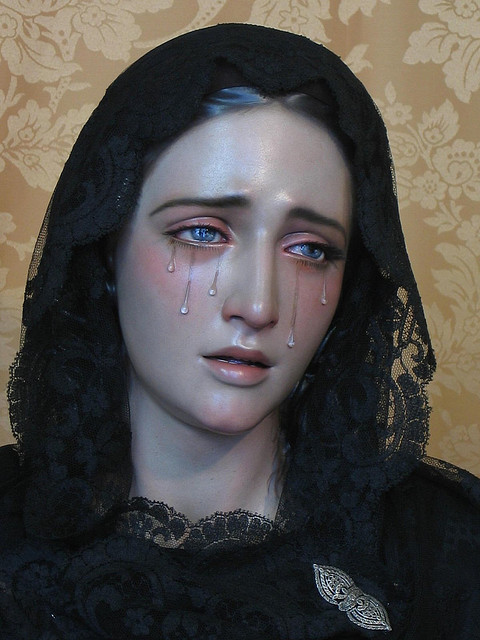
Our Lady of Sorrows

I haven't had much time lately to write.  Between Volley Ball, Color Guard, Band Practices, picking up and dropping off for school, ministry duties, and Diaconate studies and meetings (while still trying
to make sure to keep a healthy balance of time for my wife and children as my primary vocation) I just haven't had a moment to sit down and write.  I felt the need strongly today to do so.

Today is the Memorial for Our Lady of Sorrows.  That day when we recognize the pain and suffering that Our Blessed Mother went through as she stood at the foot of the cross.  Simeon phrased it well when inspired by the Holy Spirit  proclaimed in the presence of Our Lord and Lady, “Behold, this child is set for the fall and rising of many in Israel,and for a sign that is spoken against (and a sword will pierce through your own soul also), that thoughts out of many hearts may be revealed.”  (Luke 2:34-35) Today as I have gone through my morning prayerfully and considered the images and thoughts that have been put in my path, my mind is drawn back to a blog I wrote a few years ago.

A while back I had been convicted about my weight.   Not in the "you are the temple of the Lord" way that many of our Christian brothers and sisters use to encourage health (one I agree with to an extent.)  (1 Corinthians 3:16-17)  Rather I felt the need to think about my food choices in relationship to how many calories I was consuming in my comfortable first world home, while there were people starving in other countries.  At the time I was beginning to read many more books about a healthy
vegan diet vs an unhealthy one loaded with fat and Oreo cookies.  I also began to look at how heavy I had gotten.  

At my heaviest point I was 380 lbs.  That's roughly 180-200 lbs more than I should weigh according to which chart/doctor you go with.  I started wondering, what does that mean in terms of food consumed?   Well most science agrees today that it takes 3500 extra calories to gain a pound of fat.  That means (not counting all the times I had lost weight and gained it back, in a vicious cycle of indulgence) that I had consumed somewhere near 700,000 extra calories that I did not need. Wow, I thought to myself.. that's a huge number... but how can I express that in a meaningful way?  How can I express that in a way that means something?  A big number just means I had too much, I already knew that. 

So I wondered, how many calories does it take to feed one of these starving children you see in the commercials on TV.  You know the ones with Sarah McLachlan singing "In the Arms of an Angel"
in the background?  That would give me something concrete, a face to put with a number so to speak.. or faces.   So I looked into it. Somewhere over 1500 calories a day.  That's just to keep from starving.  That means for every pound I have gained, I could have feed a child for nearly two days.   At my heaviest I had literally eaten enough food to feed a starving child for over a year!  How much shame that brings to my heart.

Jesus Christ tells us in one of his may parables, a parable Mother Teresa mentioned in a very succinct and profound statement, " "At the end of life we will not be judged by how many diplomas we have received, how much money we have made, how many great things we have done.  We will be judged by "I was hungry, and you gave me something to eat, I was naked and you clothed me. I was homeless, and you took me in."    (Based on Mathew 25:31-46)  What does this have to do with starving children and Our Lady of Sorrows? 

Well, our Lady stood at the foot of the cross of Salvation and watched her own child dying a horrible, painful death.   Then as He, the God of the universe, was losing his life;  he turned and gave His mother to His beloved disciple.   You and I are that beloved disciple.   Mary is our mother, Mary is their mother.  We are all part of the body of Christ.   When that child is laying, dying of thirst and hunger in some foreign country; Christ and the Body of Christ, including the blessed Mother are there.  We are in some way responsible for that.  We who do not reach out and feed, clothe and visit those children in need.   They are bearing their cross, and she stands at the foot of it in Sorrow for their agony.  

Whatever we do for the least of these.... doesn't that mean that we should at least consider, at least have the conversation of what our food choices are doing to others in this world?  We sit here feeding thousands of pounds of grain to one animal, to make a $.99 hamburger.. instead of taking those grains and feeding those starving children.   We eat our twinkies, drink our coffee, and celebrate so many festivities, sports events, holidays, birthdays, etc at the drop of a hat.. often with much food waste and excess gluttony.   By making simple choices and then using the extra to feed the rest of the world, we can make a difference. 

Does everyone have to give up all treats? No.   Yet, it should not only be during Lent that we

consider taking part of our money and feeding someone else.  It should not only be during Lent that we make a change to our coffee and put the extra money in a CRS rice bowl or send it to Feed Em Soup.  No Lent is a time for change.. permanent change.   We are supposed to continue those changes throughout the year.  

All Saints day is coming.  Thanksgiving will soon be upon us. Advent is coming in 10 weeks.  Then Christmas before you know it.   This year let's consider making all of these times not just a time for personal celebration, but also a time of cheerful giving.  A time in which we sacrifice a little of our excess (maybe even going as far as not just giving from the excess but from the normal day to day) and then take the extra and give it away.  Let's look for ways to improve our world.  One step at a time.  One child at a time.  Even one bite at a time.


In Christ, 

Brian


Thursday, August 6, 2015

It is good that we are here!

Last night while I was out exercising with my 8 year old daughter I began meditating on the readings for today's Feast Day. To be fair, there are myriads of different messages and a vast plethora of
theological and typological things happening. So much so that you could really reflect on just about anything and find something deep in the imagery and events of those excepts from scripture. My daughter, however, in her youthful innocence said something (which I'll write about a little later) that triggered me to think about this statement of Peters.  "Rabbi, it is good that we are here!"'

  If we look back to earlier in this passage we find that Jesus has already informed them that some of them will not taste death before they see the Son of Man coming on a cloud of glory. That sounds like a very positive thing indeed. Yet, it also infers that some of them will have died as well. Facing our own mortality is never easy. Then Jesus goes on to start describing what must happen in Jerusalem, that he must go down to die a heinous death. How horrible to hear your friend, your teacher, your brother; speak of their own death in such terms.

 Then as the Holy Spirit and the glory of God is revealed in Jesus at this moment, we see that the apostles were terrified! How terrifying indeed, for it proves that not only is Jesus the Messiah, but everything he said is going to come to pass! Peter blurts out something that is a good thing, but also shows our mortality. "Rabbi, it is good that we are here! Let us make three tents: one for you, one for Moses, and one for Elijah." Why would Peter want to do this? Well it was a holy moment to be sure, and what had just happened was something amazing. I am sure he was awestruck. Also, his fear had something to do with it. Peter did not want to go back down the mountain. Going down the mountain meant facing Jesus death and betrayal. Going down the mountain meant leaving this glorious moment, where the true gory that Christ is due was revealed. Going down the mountain meant facing his own death, his own inner demons, as well.

 Why would I think of this as my daughter and I were jogging around the block? Something she said struck me as profound for her young age. We were talking about how when we jog around she really enjoys it, because she gets to see new things. She isn't always in the same spot. Then I mentioned that her mother and I had talked about going to different parks and recreational areas so that we can see new spots while we exercise. Then my daughter said the strangest thing, "Yeah but we don't want to go to Japan or China."

 I said, "Why not there? I am sure there are many beautiful gardens and things to see in those countries."

 She replied, "Because in some places there I can't say that I love Jesus! They might kill me!"

 I explained to her that while that was true in some parts, that there were many places in those countries were she would be free to talk about her love for Christ. I also explained that there were many people in those countries who also loved Jesus, and were willing to speak about it even if it meant being hurt.

 You see, just like my daughter, I'm often afraid to come down off the mountain. While some people are called to cloistered life in a monastery or nunnery, many of us are laypeople. It is our job to be the domestic church. To go out into the world and to spread the light of Christ as we go. Our environment doesn't change, rather we are to change our environment. In the second reading, Peter talks about his experience on the mountain top. "You will do well to be attentive to it, as to a lamp shining in a dark place, until day dawns and the morning star rises in your hearts." Peter reminds us that by the virtue of our baptism, we have received the Holy Spirit, and we too are lights in the world. We are not supposed to place those lights under a basket, but on a hill for all to see.

 We must experience "metanoia," a fancy Greek word meaning a complete turning around of our lives(almost a turning upside down or inside out), until we too shine with the glory of Christ. We are not supposed to spend all of our time behind closed doors. Our religion does not end when we leave the Sanctuary. We receive Christ in the Eucharist, then we are charged to go forth and share the good news with the world. We must be transfigured, and conformed to Christ so fully in our lives, that the very places that we journey can become small reminders of the glory of Christ, and in our own way help bring God's Kingdom right here to the now.

 How about you? Are you ready to come down the mountain? Are you being transfigured by the Holy Spirit to shine your light into the darkness of the world? Are you ready to be the hands and feet of Christ?

Wednesday, August 5, 2015

Hot Burn Baby

As I sat in adoration yesterday reflected on the readings for today in preparation for this mornings Communion Service, I began to muse on the actions of the Israelites as they were journeying through the desert. It reminded me of an incident in my own life from when I was a small child. My mother
had warned me over and over about the stove. She told me "Hot burn baby, and mommy too." She knew what was good for me. Being the stubborn mule of a child that I was, I didn't believe she knew better. So I waited till she was out of the room and I pulled a chair over to the stove. I turned the electric eye on as high as it would go. As soon as it was red hot I put my hand down on it. Of course.. she was right, it burned me.


She took me to the doctor and he put some salve on it. Then he told her, "you take him home and bust his butt." Why? Because I didn't listen. It's kind of like those Israelites here in the desert. In the past few days we have heard how they saw all of these miracles. They saw the plagues in Egypt. The red sea parted. Pharaoh's army swallowed up in the waters. Then when they grumbled about not having their fancy foods from Egypt, God himself provided bread from heaven miraculously on the ground for them to eat. Now he has led them day and night with a massive pillar of flame and smoke. Something to remind them every day of the power of God. He led them to the promised land and said "Here it is, everything you could ever want, fertile soil, plenty of water.. a land of milk and honey. Take it, I give it to you." They don't believe him. They grumble and complain. They spread rumors about how tough it will be. They refuse to go. They don't think the Lord knows better than the they do.


Then we see in the Gospel reading a complete turn around. We see a woman who is the "they." The enemy. The "other." She should be going to her own gods, her idols for help. Instead a Canaanite comes to a Jewish Rabbi and begs for His help. He even almost insults her, "It is not right to take the food of the children and throw it to the dogs," Jesus responds. Then she makes a declaration of faith, "Please, Lord, for even the dogs eat the scraps that fall from the table of their masters.” How powerful a statement this is! Jesus commends her faith and performs a miracle because of it.


  I think that is our lesson for today. To trust in the power of God, to trust even when it seems it might be difficult. No matter where he is calling us, no matter how difficult the odds, we should be trusting and step forth in faith. How hard would it be to swallow your pride and go to the 'enemy,' and ask them for a favor? Even after they call you a dog? Are you ready to step out in faith and go where God leads you? To undertake even those tasks that look like they are too hard to overcome? There is a beautiful saying in the 11th chapter of Luke that expresses it so well. " “Which of you fathers, if your son asks for a fish, will give him a snake instead? Or if he asks for an egg, will give him a scorpion? If you then, though you are evil, know how to give good gifts to your children, how much more will your Father in heaven give the Holy Spirit to those who ask him!” Let's believe in those promises, stepping out into the land of milk and honey. In this world of strange happenings and skewed moral compasses, we need our faith more than ever.

Sunday, July 26, 2015

The Problem of the Eunuch..

Tonight I saw someone wondering about something that I too wondered about many years ago.  You see I grew up in a church that taught people that Baptism was nothing more than a symbol.  It was kind of a public declaration, a promise ring of sorts, that you did when you were 'saved'.   You did it not because it did anything to you, but to show others that you were converted.   Not only was it only symbolic.. but you could do it as many times as you wanted, until you finally actually stuck with it.  Baptism was basically the same as saying, "Look at me, I am a Christian."

Tonight after reading some others asking themselves why get baptized then, why would Jesus command it? Etc if it were only a symbol... it struck me that there is a fatal flaw to the reasoning that it's just a symbol.  That flaw lies in the story of the the Ethiopian Eunuch in Chapter 8 of the book of Acts.

Then Philip opened his mouth, and beginning with this scripture he told him the good news of Jesus.  And as they went along the road they came to some water, and the eunuch said, “See, here is water! What is to prevent my being baptized?”  Acts 8:35-36

One has to ask themselves some logical questions and get logical answers.  That's what I love about being Catholic.  We reason things out (and people have been doing so for 2000 years.)  So what is going on here? Well the Eunuch has realized he needs someone to teach him about the Scriptures, and God sends someone along, an authority, to help him understand what he's reading.  After Philip explains it all to him, the Eunuch wants to be baptized.  Why is that a problem to 'symbolic' baptism? Well let's reason out why the Eunuch would want to do so, and why would he be excited by the prospect?

The Eunuch it says in a previous verse is had "come to Jerusalem to worship."   The Eunuch was not allowed in with the Jews, because he wasn't a Jew.  He was a gentile.  That posed a problem for the Eunuch because he was a God fearing man. The Gentiles, as you see from the image, were not allowed in the inner areas of the temple.  They could approach but not go inside.  Then the women were a little closer to God, then the men even closer, then the Priests actually in his presence.  So to 'get closer' to God, the Eunuch would have wanted to be a Jew.

There is a problem there.  He can't be a Jew.  Why not?  Well he lacks the proper equipment to be circumcised.   That means he can never become one of the children of God, one of the chosen race.  The Jewish people didn't see circumcision as just a symbol, they saw it as making you one of them.  Literally becoming one of God's people.  "I will be your God, and you will be my people."   Circumcision then was something the Eunuch would have wanted badly but could never do.  He would always be an outsider.  Always in the outer court of the Gentiles, never one of the 'in crowd.'

Why then would baptism seem like something he would want? Because he realizes that there is nothing preventing him from becoming part of the Body of Christ.  He doesn't say to Philip, hey thanks, I believe.  He rather says, "Here is water, let's do this!"   He's excited because God has just made a way for any man, not just the ones who are 'complete' in their body, but even those who have been disfigured can now become part of the family of God.  He can become of the Children of God now, via Baptism.  Baptism meant something to him, because it was more than a public confession.. it was a Sacrament!

More verses to read and study: Matthew 3:16; Matthew 28:19; Mark 1:8; Mark 16:16; John 3:5; Acts 1:4-5; Acts 2:38; Acts 8:16; Acts 8:36-38; Acts 11:16; Acts 16:15; Acts 16:33; Acts 18:8; Acts 19:3-6; Acts 22:16; Romans 6:3-4; 1 Cor. 12:13; Eph. 5:25-26; Col. 2:12; 1 Peter 3:20-21,